Battery Life Information
w High Performance Flexible Solar Panels |
  |
Portable electronic equipment consumes power as Amps (Amperes)
at various rates depending upon the type of equipment and what types of
functions are being used.
In general heaters, pumps & motors (physical
motion), and
bright
lights consume much more power than small
electronics, non-motorized equipment and dim
lights.
It is important to remember:
Batteries store power, for use on demand ...in a short time.
Recharge is slow, low amp, trickle charge ...over a long time.
Therefore, power consumption is faster than replenishment.
The more Amps consumed, the faster a battery charge is depleted.
Batteries are also limited by their inherent chemistry as to how fast
they
can deliver electron flow; AmpHr capacity is based upon battery slow drain
over ten to twenty hours. Due to the electro chemical properties
of batteries, there is a practical limit of about 2.5 Amps maximum for
equipment to be powered by any battery system.
To determine how long a piece of equipment may run in hours using a
fully charged battery, one simply divides:
battery AmpHrs capacity / Amps a device uses
Theoretically, an 18 AmpHr battery could run a 1.8 Amp device for 10
hours ...at 100% efficiency.
However, batteries and inverters are not that efficient.
Due to chemical and physical limitations of batteries and inverters,
we recommend use of 60% efficiency for practical expectations. So,
to estimate practical operating life:
Hours = AmpHrs / Amps x .60
If you only know the wattage of a device you may calculate Amps for
estimation purposes using:
Amps = Watts / Volts
|
 |
BullDog™
PowerPak™
Portable
Power
Systems |
 |
 Solar/DC/AC
Rechargeable Solar/DC/AC
Rechargeable
110v Portable Power Systems |
.
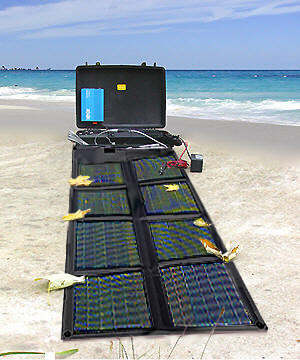
BullDog™ PowerPak™
Note: power conversion and battery life are subject
to a wide number of variables. These include chemical potential charges,
environment temperature, circuit thermal resistance, as well as load factors
of equipment connected to the system. Also, because of loss through
the inverter, Amps (AC) are less than Amps (DC) actually consumed.
Each of these variables are impossible to estimate for general purposes.
Therefore any estimation is inherently imprecise. Assuming 60% efficiency
should yield a practical expectation. |
| See the Equipment table for examples
of typical power consumption for various types of portable electronics.
Battery Life calculations are further complicated
by simultaneous recharge using solar panels, or 12vDC connections.
In this case recharge Amps IN are roughly equivalent to utilized Amps OUT.
For Example:
-
If your equipment consumes 1.8 Amps, but a solar panel is simultaneously
resupplying the battery with 1.2 Amps, then the net consumption is only
.6 Amps. At that very low consumption per hour, an 18 AmpHr battery
would theoretically last 30 hours. In this example you could run
your gadget all day without problem.
(note: very few places on earth have 30 hours of uninterrupted
sunlight at any given time of year)
-
Alternately, if your equipment consumes 7 Amps (too much), solar panel
provides 1.2 Amps, net 5.8 Amp consumption. 18 AmpHr battery would
last only 3.1 hours at 100% efficiency (more realistically, 2 hours), even
with the solar panel. In this example to increase battery life, you
need to reduce Amp consumption (turn off equipment, reduce brightness,
etc.) and/or use additional solar panels to increase recharge 1.2 Amps
per additional panel.
-
Doing so, equipment reduced to 6 Amps, using (3) solar panels providing
1.2 Amps each (for 3.6 Amps INput), net 2.4 Amp consumption. 18 AmpHr
battery could now last 7.5 hours at 100% efficiency in continuous use (at
60% efficiency, 4.5 hours).
In any case, when equipment use is ended, the system battery can be fully
recharged via solar, DC vehicle system or the AC recharger.
The time to fully recharge the battery depends upon the AmpHr size of
the system battery, how low the battery was discharged, and input Amperage.
See Recharge Chart at below right. |
.
top of page, Solar
Panels, BullDog™ PowerPak™
| Battery
Life (Hrs) ¹ |
Battery
Life (Hrs) ²
(w 20watt
1.2amp solar panel) |
Equipment¹
Amps/hr # |
BatteryAmpHrs (AH) |
Net²
Amps/hr
(OUT vs IN) |
BatteryAmpHrs (AH) |
| 7AH |
18AH |
34AH |
7AH |
18AH |
34AH |
0.5
1
2
3
4 |
14
7
3.5
2.3
1.8 |
36
18
9
6
4.5 |
68
34
17
11.3
8.5 |
-0.7
-0.2
0.8
1.8
2.8 |
no loss
no loss
8.8
3.9
2.5 |
no loss
no loss
22.5
10.0
6.4 |
no loss
no loss
42.5
18.9
12.1 |
¹ Equipment Amps OUT only, no
solar panel or other INput connected.
..²
Equipment Amps OUT minus 1.2 Amps IN from single 20watt solar panel connected
simultaneously with equipment utilization.
#Not recommended for use with equipment drawing more
than 2.5 Amps, for a period longer than ten minutes. |
| Battery
Recharge (Hrs) |
| Source |
INput
Amps/hr |
Battery (AmpHrs) |
| 7AH |
18AH |
34AH |
5watt panel
10watt panels
20watt panels
25watt panels
40watt panels
60watt panels
80watt panels
12vDC vehicle†
AC Charger‡
AC Charger‡ |
0.3
0.6
1.2
1.5
2.4
3.6
4.8
4
1.2
2 |
23.3
11.7
5.8
4.7
2.9
1.9
1.5
1.8
5.8
3.5 |
60.0
30.0
15.0
12.0
7.5
5.0
3.8
4.5
15
9 |
113.3
56.7
28.3
22.7
14.2
9.4
7.1
8.5
28.3
17 |
Assuming Battery fully discharged,
No Equipment connected,
1.2 Amps IN per 20watt solar panel.
†Amps IN from vehicle may vary.
‡Amps IN from AC Charger auto regulated,
actual time may vary. |
.
| Typical Electronic
Equipment # |
Power
Consumption |
Max
Hours *
BatteryAmpHrs (AH) |
| 7AH |
18AH |
34AH |
Medical Electronic
Monitor
Small Portable Printer
Notebook Computer
Personal Computer (full size)
Large Portable TV/CRT monitor
Small Portable TV/LCD monitor
Very Small Portable TV/radio
Stereo Amplifier
Boom Box
DVD player (only)
100watt Light Bulb
40watt Light Bulb
25watt AC charger (typical)
PalmPilot
Cell Fon |
2.5 Amps¹
1.5 Amps¹
3.0 Amps¹
3.5 Amps¹
2.0 Amps
.8 Amps
40mAmps
2.4 Amps
1.2 Amps
.2 Amps
0.9 Amp
0.36 Amp
.25 Amp
0.4 Amp
90mAmps |
2.8
4.7
2.3
2
3.5
8.75
175
2.9
5.8
35
7.8
19.4
28
17.5
77 |
7.2
12
6
5
9
22.5
450
7.5
15
90
20
50
72
45
200 |
13.6
22.7
11.3
9.7
17
42.5
850
14
28
170
38
94
136
85
377 |
* All times estimated at max
efficiency. Hours calculated as Equipment Amps into battery AmpHr (AH),
assuming battery in original condition, fully charged, and WITHOUT simultaneous
recharge from solar panels.
#Not recommended for use with equipment drawing more
than 2.5 Amps for a period longer than ten minutes.
¹ Equipment power consumption varies over time of
use. Actual time depends on specific equipment model, settings and
specifications.
Use with solar panels considerably
extends battery life / operating time. |
Special direct DC output versions,
fully universal international 110/220vAC versions and other specialty custom
versions available.
Contact
us for further information. |
© 2016 GeoData Systems Management
Inc.
All Rights Reserved
|

 ..
..
